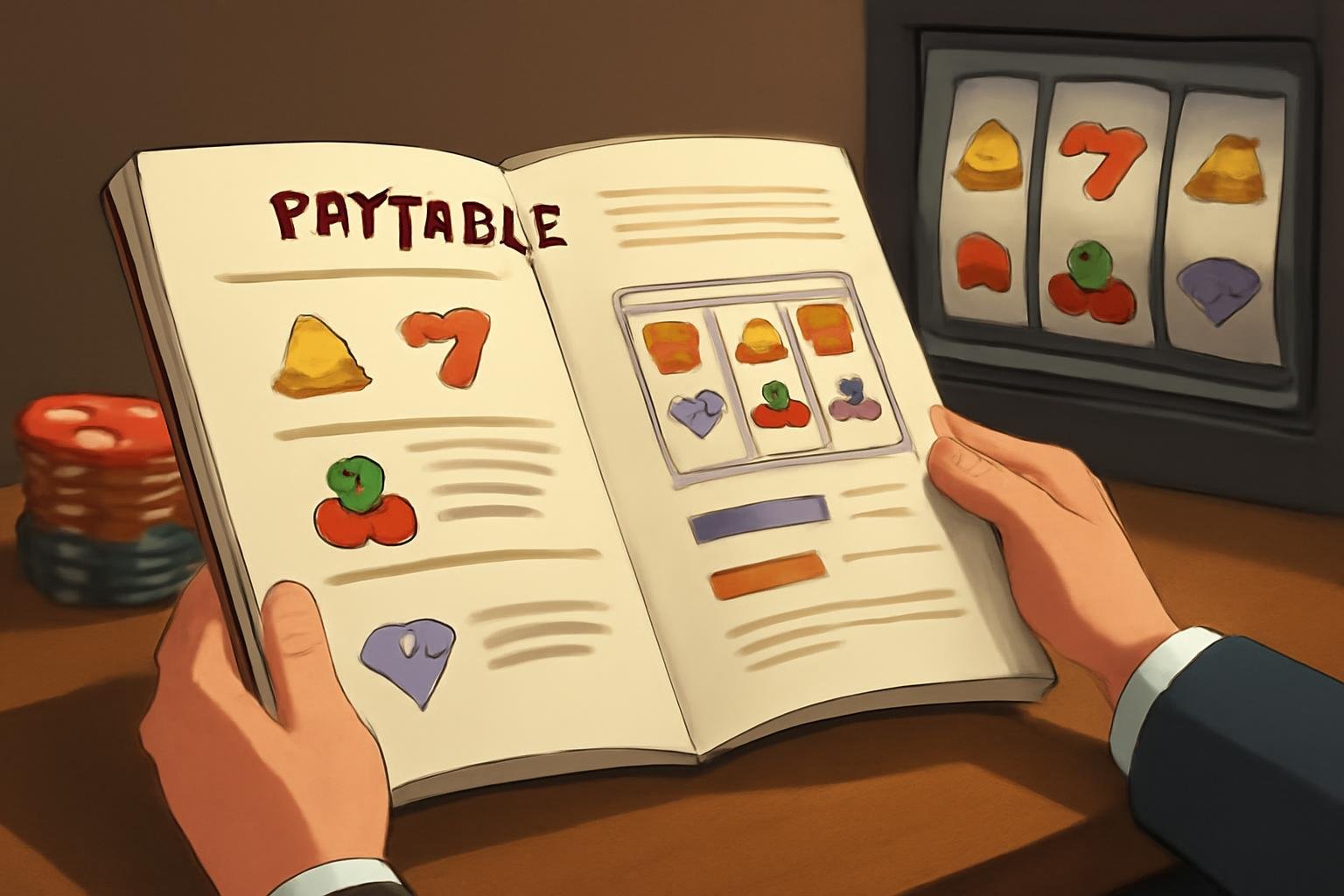
A slot’s paytable is its instruction manual: it explains what symbols do, how wins are formed, and which features may affect a round. Spending a few minutes with it can help you understand what the game offers without mistaking artwork or promotional language for useful information. The details vary by game, so use the paytable for the specific slot you are considering.
Start with the game’s rules and symbol values
Open the information, help, or rules panel before starting. Look for the basic rules first: how many reels or rows the game uses, how a winning combination is formed, and whether wins must appear on paylines, ways-to-win paths, or another pattern. A line-based game may require matching symbols along an active line; a game with ways-to-win may use a different rule. Don’t assume one slot works like another.
Next, check the symbol list. Paytables commonly distinguish regular symbols from special ones, such as wilds or scatters, but their exact functions are game-specific. A wild might substitute for some symbols, while another special symbol might trigger a feature only under stated conditions. Read any exceptions: a symbol may not replace every symbol, or a feature may require a particular number of symbols.
Understand the numbers in context
RTP is a theoretical measure, not a session forecast
If the game lists a return to player (RTP) percentage, treat it as a theoretical figure associated with the game’s design and the stated conditions—not as a promise about what you will get back during a short session. Individual results can vary, and the RTP figure does not predict the outcome of your next spin. If multiple RTP settings are listed or the information is unclear, check the game rules and the operator’s available details rather than guessing.
Volatility describes the pattern of risk
Volatility, sometimes described as variance, is a broad way to characterize how results may be distributed over time. A higher-volatility game may have less frequent wins with more variation in outcomes; a lower-volatility game may produce a different pattern. These labels do not tell you whether a particular spin will win, and they are not a measure of which game is “better.” If a paytable does not explain its volatility, avoid inferring it from the theme or graphics.
Check paylines, bet settings, and feature costs
Find out whether the game has fixed paylines or lets you choose how many lines are active. Also check how the total stake is calculated: it may depend on the coin value, bet level, active lines, or another setting. Before starting, confirm the amount shown for a single spin. If a bonus feature can be purchased, read its separate terms and cost; it is an optional feature, not a guarantee of a favorable result.
A quick paytable checklist
- How does the game form a win, and in what direction are combinations counted?
- What does each special symbol do, and are there exceptions?
- How is the stake per spin calculated?
- What do the listed RTP and volatility details mean—and what do they not tell you?
- Are bonus rounds, feature buys, or other special modes explained separately?
- Can you find the rules again easily if a feature is unclear?
Use the information to set boundaries
Understanding a paytable can make the rules clearer, but it cannot remove the uncertainty of gambling or turn a slot into a reliable way to make money. Decide in advance what amount and time, if any, you are comfortable spending, and stop when you reach either limit. Never increase a stake to try to recover a loss. If the game’s terms are hard to find or do not answer basic questions, choosing not to play is a reasonable option.
For more background, see this site’s introductory guide to online slots, its overview of ways to compare slot games, and its article on casino game developers. The practical takeaway is simple: read the rules for the exact game, verify the stake settings, and treat every listed figure as information—not a prediction.